News provided by CBC News – link to full story and updates
Exceptions will be in place for U.S. citizens, diplomats, crew and immediate family members of citizens
Kathleen Harris · CBC News · Posted: Mar 16, 2020

Prime Minister Justin Trudeau addresses Canadians from self-isolation on the COVID-19 situation.
Canada is barring entry to all travellers who are not Canadian citizens or permanent residents, Prime Minister Justin Trudeau announced today.
There will be exceptions for air crew, diplomats, immediate family members of citizens and, “at this time,” U.S. citizens, Trudeau said.
The prime minister also said no one who is displaying symptoms will be permitted to board a flight to Canada, and that air operators will be required to complete a basic health assessment of every passenger based on guidelines from the Public Health Agency of Canada.
“I know this news will spark concern among Canadians travelling abroad. I want to assure you than our government will not leave you unsupported,” he said.
“To help asymptomatic Canadians to return home, our government will set up a support program for Canadians who need to get on a plane. Canadian travellers will be able to get financial assistance to help them with the costs of returning home or temporarily covering basic needs while they wait to come back to Canada.”
As another measure to prevent the spread of the novel coronavirus, Trudeau said international flights will be funnelled to airports in Montreal, Toronto, Calgary and Vancouver to enhance screening.
CBC News is streaming the prime minister’s comments live.
The Canada Border Services Agency (CBSA) is stepping up manpower, educational materials and screening measures at airports and all other entry points to Canada to help stop the spread of COVID-19.
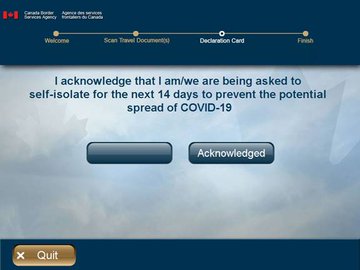
All travellers seeking entry into Canada will have to answer the health screening questions and CBSA officers will be on the lookout for visible signs of illness. They will refer any traveller who they suspect of being ill, regardless of how the traveller answered the health screening question, to public health authorities for further evaluation.
A number of top cabinet ministers leading the COVID-19 response will also hold a news conference in Ottawa.
During a news conference in Toronto Monday, Ontario Premier Doug Ford urged the federal government to do more to contain the virus, including closing the border to all visitors. He said the border could remain open for trade and commerce, and to Canadian citizens returning home from other countries.
“I’m very concerned about reports coming out of the border. We need the federal government to tighten up the border and ensure proper screening and protocols are being enforced, and be prepared to take even greater steps to protect the health and safety of all Canadians,” Ford said.
There are now about 375 presumptive and confirmed cases of COVID-19 in Canada.
The CBSA said it is adjusting its “operational posture” with enhanced border measures, and will continue to adjust to the “constantly evolving” situation.
CBSA is committed to limiting the spread of COVID-19 in Canada, while facilitating travel and trade,” said a statement from spokesperson Ashley Lemire.
“Entry screening alone is an important public health tool among others during periods of uncertainty and part of a multilayered government response strategy.”
Beefed-up border measures include:
- Enhanced officer presence at major points of entry to carry out public health screening and public health outreach by observing arriving travellers and making sure they’re aware of Public Health Agency of Canada (PHAC) guidelines. CBSA officers will approach any traveller displaying signs of illness for further questioning and will distribute PHAC pamphlets to raise more awareness about COVID-19.
- Instructional handouts will be given to all travellers arriving in Canada advising them to self-isolate at home for 14 days, monitor themselves for symptoms and to contact public health authorities if they develop symptoms.
- Increased signage will be displayed at all ports of entry for travellers to see throughout processing so travellers understand the importance of monitoring their health and contacting their provincial health authorities if they become ill.
- Travellers will be asked to fill out a PHAC coronavirus form, which will help health authorities monitor and track people who have been identified as a potential concern.
- Mask kits will be given to travellers “of concern,” which includes a surgical mask and a one-page instruction on how to use the mask.
“These measures complement routine traveller screening procedures already in place to prepare for, detect and respond to the spread of serious infectious diseases into and within Canada,” Lemire said in the statement.
“CBSA officers remain vigilant and are highly trained to identify travellers seeking entry into Canada who may pose a health and safety risk.”
