
Dorval, Quebec, 4 May 2023 — Today, the Transportation Safety Board of Canada (TSB) released its investigation report (A22Q0116) into a September 2022 fatal collision with terrain following the in-flight separation of the left wing of a Wag-Aero Sportsman 2+2 (amateur-built floatplane), near the Rivière Bonnard Aerodrome in Quebec.
The TSB conducted a limited-scope class 4 investigation into this occurrence to advance transportation safety through greater awareness of potential safety issues. See the Policy on Occurrence Classification for more information.
The TSB is an independent agency that investigates air, marine, pipeline, and rail transportation occurrences. Its sole aim is the advancement of transportation safety. It is not the function of the Board to assign fault or determine civil or criminal liability.
Air transportation safety investigation report A22Q0116
In-flight separation of left wing
Privately registered
Wag-Aero Sportsman 2+2 (amateur-built floatplane), C-FFDA
Rivière Bonnard Aerodrome, Quebec, 13 NM WSW
23 September 2022
History of the flight
At approximately 0830Footnote1 on 23 September 2022, the Wag‑Aero Sportsman 2+2 amateur-built floatplane (registration C‑FFDA, serial number 792), with the pilot and 1 passenger on board, took off from Lake Mylène, 12 nautical miles west of the Rivière Bonnard Aerodrome (CRB4), Quebec, to conduct a local visual flight rules flight.
Approximately 4 nautical miles south of Lake Mylène, the floatplane’s left wing separated completely, resulting in an uncontrolled descent of the floatplane, which then struck the terrain. The 2 occupants were fatally injured. The floatplane was destroyed by the force of the impact. There was no post-impact fire. The 406 MHz emergency locator transmitter activated, and the Cospas-Sarsat search and rescue satellite system detected the signal at 0846.
Weather information
According to Environment and Climate Change Canada observations for the area of CRB4, located 13 NM east-northeast of the accident site, winds were from the west-northwest between 13 and 17 km/h (7 to 9 knots) between 0800 and 0900 on the day of the occurrence. The temperature was 4 °C, and the dew point was 2 °C.
The graphic area forecasts valid at the time of the occurrence indicated moderate mechanical turbulence between the surface and 3000 feet above ground level (AGL) and, occasionally, towering cumulus clouds topped at 14 000 feet above sea level, ceilings at 1200 feet AGL, and visibility of 2 to 5 statute miles in light rain and snow showers and/or mist.
Pilot information
The pilot held the appropriate licence and ratings to conduct the occurrence flight in accordance with existing regulations: he had a private pilot licence issued in 1989 and a valid Category 3 medical certificate. The pilot had accumulated over 4400 flight hours, almost all of them on the occurrence aircraft.
According to information gathered during the investigation, there was no indication that the pilot’s performance was affected by medical or physiological factors.
Aircraft information
The aircraft—an amateur-built floatplane—had been built by the occurrence pilot in 1989. According to the aircraft’s journey log, on 04 September 2022, the aircraft had accumulated 4422 flight hours since it was built.
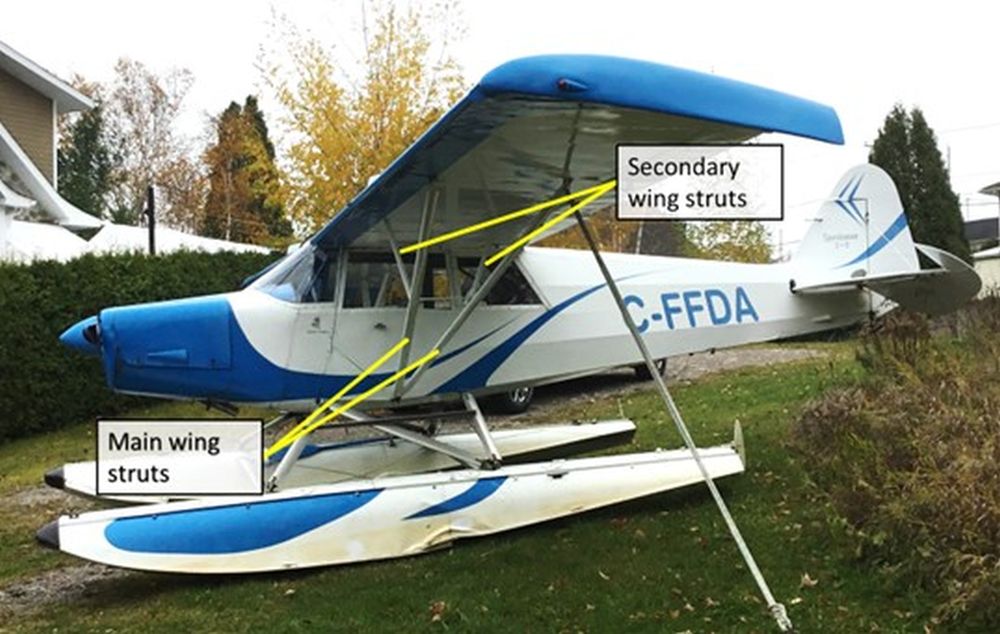
The floatplane was equipped with a 200 hp Avco Lycoming IO-360-A1B6 engine (serial number L-59367A). Each wing was supported by 2 main wing struts and 2 secondary wing struts (Figure 1).