
November 02, 2022 | Blog, General
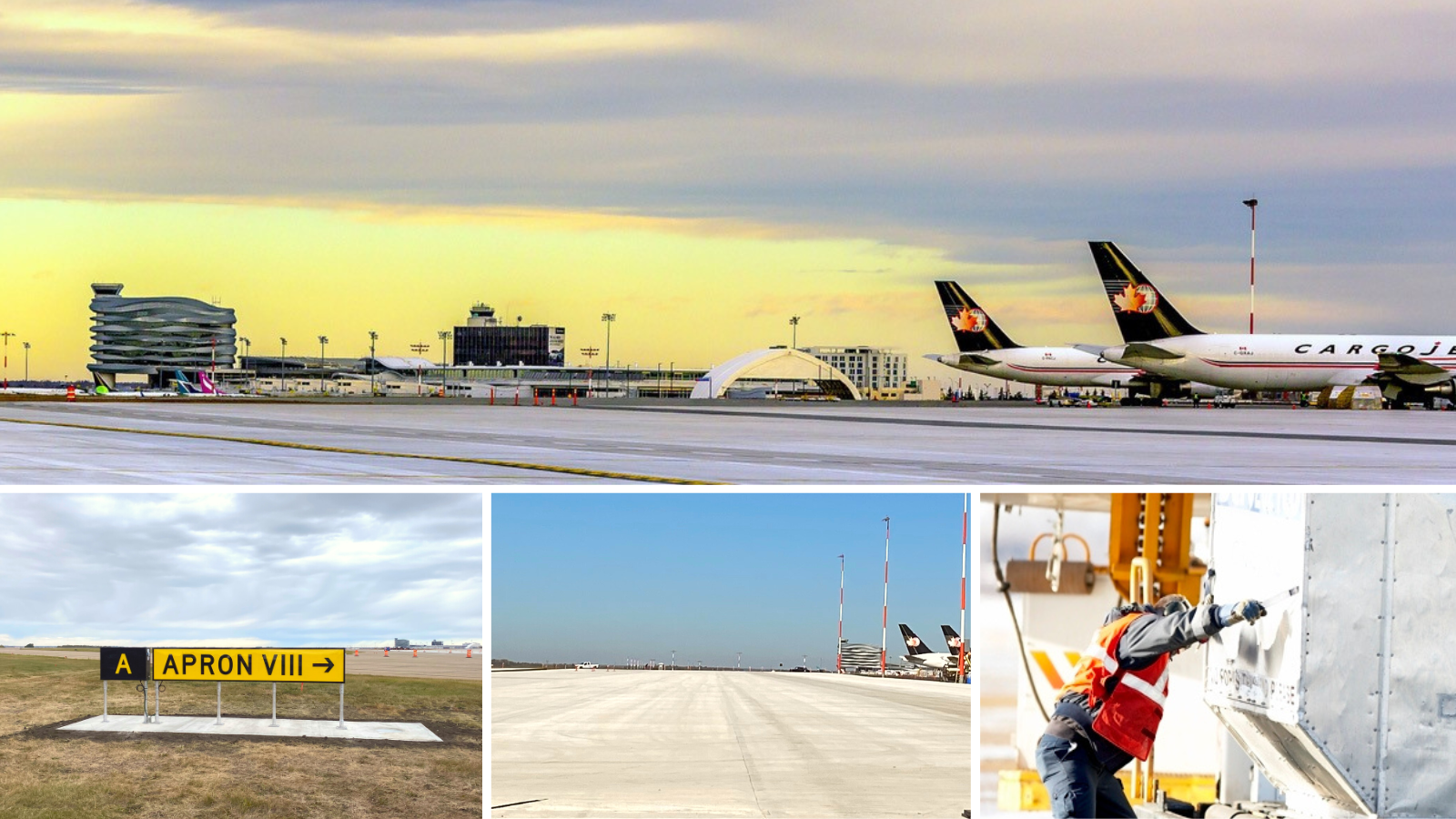
YEG completes 47,000 square meter expansion to cargo apron.
Construction on the new 47,000 m2 cargo apron expansion at Edmonton International Airport (YEG) finished at the end of September. The expanded cargo area is equivalent to five-and-a-half CFL football fields and can hold six more widebody aircraft, such as four 747s or six 767s.
In 2021, YEG received an $18M grant from the Government of Canada under the National Trades Corridor Fund to support a $36M total expansion of cargo operations. The airport contributed the other 50 per cent of the required funding.
Next on the list is installing a new hydrant fueling system that will tie into Shell Aviation’s two new, two-million litre fuel tanks. Having the hydrant fueling system right on the cargo apron will eliminate the need for tanker trucks to move fuel to aircraft, making operations safer, more efficient and better for the environment.
YEG uses sustainable concrete and recycled materials on cargo apron
With concrete being seven per cent of global emissions today, YEG makes it a top priority to reduce carbon emissions on projects at the airport. The expanded cargo apron was constructed using sustainable concrete with CarbonCure technology in the production process. This technology injects a precise dosage of captured carbon dioxide into the concrete during mixing. When the carbon dioxide reacts with the cement, it mineralizes and becomes permanently stored in the concrete. Essentially, it converts carbon dioxide into stone.
YEG also recycled materials on the cargo apron project, including:
- saving asphalt from the existing service road and stockpiling it for future road rehabilitation
- using subbase and granular base from previous projects and reusing it in the pavement granular
- saving excavated clay from the construction site and stockpiling it for future fill on other projects
Cargo demand increases at Edmonton International Airport
For the past two years, YEG saw a surge in activity from dedicated cargo operators looking for a freighter-friendly airport providing a high standard of uninterrupted service. In 2021, cargo moving through YEG set records with an almost 13 per cent increase over the pre-pandemic baseline. The increase in cargo tonnage is remarkable because passenger flights and associated belly-cargo capacity was still reduced from pre-pandemic levels. For the first half of 2022, cargo volumes have grown 20 per cent compared to the previous year, and the trajectory continues upward for the future.
Why is Edmonton International Airport an important cargo hub?
By circumpolar routes, YEG is Canada’s closest major airport to many parts of Asia. For example, the Edmonton to Beijing flight path is the shortest of any major city in North America. Also, there is only about nine minutes difference in flight time from Edmonton to Hong Kong or Shanghai compared to Vancouver. When utilizing the earth’s curvature to improve supply chain efficiencies, YEG is a strategic location to access Europe, the Middle East and Africa. It has become a significant entry point into North America or Latin America. Edmonton’s proximity and connectivity to countries around the world provide a natural advantage and facilitate opportunities for more travel, trade and strategic partnerships.
YEG is Canada’s largest airport by land mass at over 7,000 acres, with uninhibited room to grow cargo-focused infrastructure well into the future.
Learn more about cargo at Edmonton International Airport.